  |
WHO IS WALKER ACCORDION?
  |
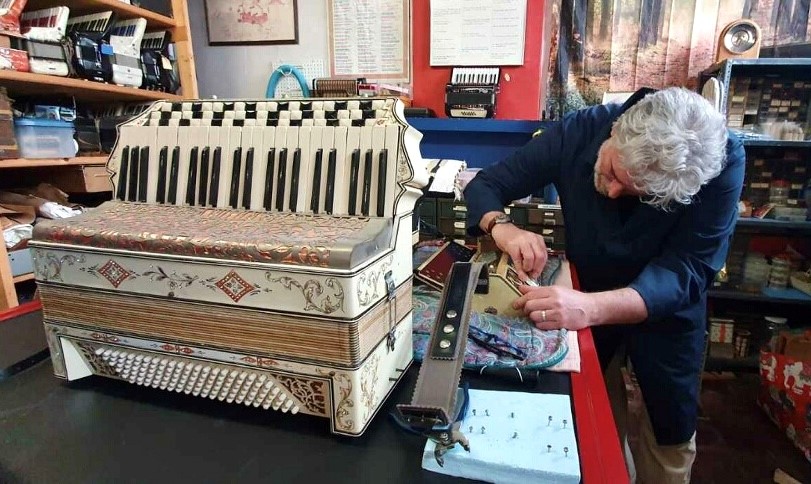
Chad Walker, owner/operator
  |
MUSICAL BEGINNINGS
Sitting on the floor in front of the console television at his grandparent’s house in the 1970s, his grandfather in his chair behind him, together watching Myron Floren play the accordion with the Lawrence Welk Orchestra, Chad Walker was unaware of how the foreshadowing of this weekly event, replicated in countless homes across the country, would manifest for him personally.
Chad is a lifelong musician, starting on voice and viola in his rural, state college hometown in Wisconsin, singing in choirs, playing in orchestras, and taking lessons from elementary through high school. A few weeks of each summer found him at UW-Madison attending their music and theater clinics, living in the same dorm as when he later started college. He spent the summer between middle and high school on a European concert tour with a youth orchestra comprised of students from around the US, who had the unique opportunity of performing in ancient cathedrals and modern concert halls for large, appreciative audiences.
The ear training gained by years of participation in vocal jazz ensembles at school, along with an extra curricular a cappella doo-wop group in the mid-late 1980s, would later prove invaluable when working on what is considered to be the most difficult instrument to tune, ie the accordion, and has helped to foster his reputation as a top tier tuner, with extensive experience on dry concert or wet musette tuning.
The use of a viola bow is much like that of an accordion bellows. One must be similarly aware of how much time is available in either direction, to ensure that a phrase can be completed without interruption, stutter or awkward breath. Subtle changes in dynamics are commonly achieved with controlled pressure/release of the bow or bellows. Another bit of training and experience that translated directly to the accordion.
Chad is also self-taught on piano and other keyboard instruments. In his late teens he played in a band, and lugged around a Hammond organ with a 2-speed Leslie and a Rhodes stage piano and amp, an experience which would soon serve to highlight the accordion as a potential, much lighter, more easily portable acoustic alternative.
INTRODUCTION TO THE ACCORDION
After a couple of years in California where he met his wife, in 1993 they moved to Austin, TX to be closer to her family for the birth of their first child.
It was there, while living in a little house behind a larger house in south Austin, that Chad first engaged with the accordion.
A resident of the front house was filming a PBS documentary on conjunto music, the musical by-product of Mexican and German farm workers in south Texas playing their instruments and sharing their songs together on the weekend.
After seeing the footage, Chad sought out shows in Austin and San Antonio of some of the living forefathers of conjunto, like Valerio Longoria, Santiago Jimenez Jr, and Mingo Saldivar, and was captivated by their playing.
Borrowing an extra piano accordion from his filmmaker friend, Chad began to take lessons with his teacher, Hanni Strahl, a German immigrant in her mid ‘80s with big red eyeglass frames who had worked at the Hohner factory, then serviced and sold accordions and taught lessons in Texas for decades, but whom most readers would likely know better as the mother of Dr. Helmi Harrington.
Hanni took a liking to Chad, his prior musical experience helped him to advance quickly in the Palmer-Hughes book series, and he was soon asked to join her ensemble for public performances.
Chad was known to his family as a tinkerer growing up. He liked to find out how things worked, how to take them apart and put them back together. He was often tasked with fixing things at home. This curiosity naturally extended to an instrument as complex as the accordion, enough that Chad would ask Hanni if she or he could open one during a lesson and show him how it worked. She said no.
ACCORDION REPAIR SCHOOL
In the next lesson, Hanni suggested Chad attend what was then the only place in the world to achieve certification as an accordion technician, her daughter Helmi Harrington’s accordion repair school, which had recently relocated from Red Wing to Duluth, MN.
Chad and his wife agreed, and made plans to move to Duluth to attend the next available term, planning to return to Austin after graduation to open a workshop there.
Accordion Repair and Technicians’ School, or ARTS, offered a year-long course in accordion history, development, original music, performance, tuning, repair, and electronics. Helmi Harrington was an inimitable wealth of knowledge and practical experience with the instrument family, who had attracted students from throughout the US, Canada and Europe, all training to be one of the “keepers of the information.”
The school was housed within an old church, with hundreds of accordions of all ages, varieties and systems displayed on shelves along the outer walls, or lined up front to back spanning dozens of pews. The students could pick up, play, open and interact with all of them, an invaluable opportunity unique to this place. The work stations, bathrooms and kitchen were in the church basement.
In order to graduate, basic performance proficiency was required on all members of the accordion family, from bandoneon to bayan. Pop quizzes were given when Helmi would point to an instrument, maybe a button chromatic without any treble markings, or a random Chemnitz concertina, and the student would have to play a simple song on the spot with both hands.
The students were required to give many public performances. Often they welcomed foreign cruise ships into the Duluth harbor, the U.S.’s westernmost port accessible from the Atlantic Ocean.
In another quiz, the hundreds of pieces of a stradella bass machine were taken apart, put into a paper grocery bag, shaken, then sorted and put back together, because surely there would be a handy future client who would attempt to fix a bass machine on their own, only to humbly deliver the result to the repair shop in a paper bag.
ARTS featured a large listening library where students were exposed to artists of every available era, style and genre of accordion music, from all over the world, with follow-up discussions on what type of accordions the performers used, how they used them, and the particular strengths and weaknesses of the varying instruments in any given repertoire.
At the graduation ceremony, Chad was presented with the weighty honorific of “Distinguished Achievement in the Development of Technical Matters” or as later put in plainer terms by Helmi, the best technician ever to graduate from ARTS.
Although Chad’s class was the last to achieve full certification from ARTS, one can still tour the World of Accordions Museum, now found across the bridge in Superior, WI, a board-managed nonprofit, serviced by volunteers, where the thousands of accordions curated by Helmi over many decades are on display. Public concerts featuring some of the world’s top accordionists are presented in the museum’s large concert hall.
ERNEST DEFFNER/TITANO/PANCORDION
Faithe Deffner, owner of the Ernest Deffner Co (mother company of brands Titano and PANcordion) had been asking Helmi to suggest a suitable candidate from among her students for the position of lead technician for Titano and PANcordion in New York, to replace the longtime lead technician who was retiring to his home country of Italy.
During the school year, Helmi and her ARTS students had traveled to Chicago to attend and perform at the annual ATG convention (Accordionists and Teachers Guild, International) where Chad and Faithe were introduced in person. Faithe soon offered the position to Chad, he accepted, and he and his wife made plans to move to NY after graduation.
For six years, Chad lead the Titano/PANcordion workshop on Long Island, with a small crew of technicians. This was his graduate school.
It was trial by fire, honing his skills by servicing the accordions of venerable Titano artists such as Pauline Oliveros, Guy Klucevsek, William Schimmel, Mary Tokarski, Joan Sommers, Kevin Friedrich, and renowned PANcordion artists like Myron Floren, Joey MIskulin, and Don Lipovac, among many others.
Chad wishes that he could tell his grandfather, who had passed by that time, the story of working on Myron Floren’s favorite PANcordion. We’ll share it here.
As the story goes, that PANcordion was stolen, traveled an unknown path for some years, and eventually turned up at a convent. When the sisters traced the serial number and discovered the unique provenance of the accordion in their possession, they contacted Faithe Deffner and sent it to PANcordion for service and an ultimate return to Myron.
Unfortunately, the accordion was not adequately secured within its shipping carton, and received extensive damage during the trip to NY. Chad was then tasked with putting the beloved and broken accordion back together, tuning it, then calling Myron at his home in California to play the accordion for him, making sure that the familiar, custom musette heard on the Welk Show was done to his liking. It was. Chad would later refer to that particular musette tuning as “champagne style.”
He also had the opportunity to play Lawrence Welk’s signature PANcordion, which was more successfully sent in to Deffner for service by the Welk organization, featuring a champagne glass and bubbles on the front of the treble section.
During his time in NY, Chad held a seat on the board of the American Accordionists’ Association, adding the perspective of a technician to an esteemed and accomplished group of educators and performers. Meetings were held in a private dining room in the back of an old Italian restaurant in the West Village.
He worked closely with Faithe on many aspects of the business, learning from her considerable and wide ranging experience, whether at Deffner headquarters on Long Island, or while exhibiting at national conventions around the country, from how to work with clients, make ads or promotions, how to print and bind sheet music from the heritage publishing houses saved from extinction by Faithe, to how to most efficiently resize a double-walled accordion shipping carton.
The events of September 11, 2001 and its sustained local aftermath helped Chad and his wife decide to move their kids away from the NY metro area and closer to family and friends. Chad offered more than two years notice to Faithe, in order to fully train his replacement.
WALKER ACCORDION SOUTH
In 2004, Chad and his family moved from Long Island back to Austin, TX where Chad opened Walker Accordion as an independent repair shop.
Over the next decade and a half, Chad cultivated a strong client base in the Austin music scene, throughout Texas and beyond, buttressed by the reputation he had earned at Titano/PANcordion. Word of mouth spread. Touring accordionists stopped in when they were in town. Many impromptu performances were heard within the walls of the workshop over the years.
The accordion appears in nearly every genre of music, and that was exemplified by its wide and varied use throughout the “Live Music Capital of the World.” From conjunto to polka, forró to tango, cowboy to classical, swing to standards, there is a group, band, or ensemble using an accordion. Prominent Austin accordionists like Mike Maddux, Jan Flemming, Glover Gill, Debra Peters, Justin Sherburn, Stefano Intelisano and many others were frequent clients.
UT-Austin offered a Middle Eastern music studies program, with a large ensemble performing music on traditional instruments, including the accordion. Chad was tasked to tune the black keys on their accordions to quarter tones in only one bellows direction, in order to provide the additional notes available in the scales used in that style of music.
It was in Austin where Chad developed a longtime working relationship and friendship with grammy-nominated accordionist Alex Meixner, and other Wurstfest favorites.
Upon becoming empty nesters in 2017, and after nearly 25 years in major cities including 10 consecutive years as high school marching band parents in Texas, Chad and his wife decided to move away from ever-expanding Austin and made plans to head back to the relative calm of his homeland of Wisconsin.
WALKER ACCORDION NORTH
Since 2018, Chad has operated an independent repair shop in Wisconsin Rapids, WI.
The town’s central location in the state is a convenient, equal distance between the northern accordion hubs of the Twin Cities and Milwaukee.
Word of mouth has spread throughout the Midwest polka scene, with circuit favorites like Ted Lange, John Wudtke, Becky Livermore, Mike Schneider, and many others as satisfied clients and advocates.
His work is heard on dozens of recordings, at major league ball fields, the Grand Ole Opry, Carnegie Hall, Lincoln Center, the White House, and hundreds of tents, bars, churches and concert halls across the country.
Some of the jobs Chad most enjoys are restoring a cherished family heirloom that may have sat idle on a shelf for many years, silently eliciting sentimental memories for those who walk past of the songs it played and of the person who played them.
To bear witness to the expressions on the faces of those picking up the accordion after it’s been serviced and they first hear its familiar voice again is a deeply personal and transcendent experience not offered by most professions, often accompanied by joyful tears.
Chad continues to play for pleasure every day, on whatever various members of the accordion family happen to be in the workshop, or accompanying his voice on guitar in his off hours.
| |
An accordion is two typewriters held together by a bellows filled with wooden harmonicas.
-Chad Walker